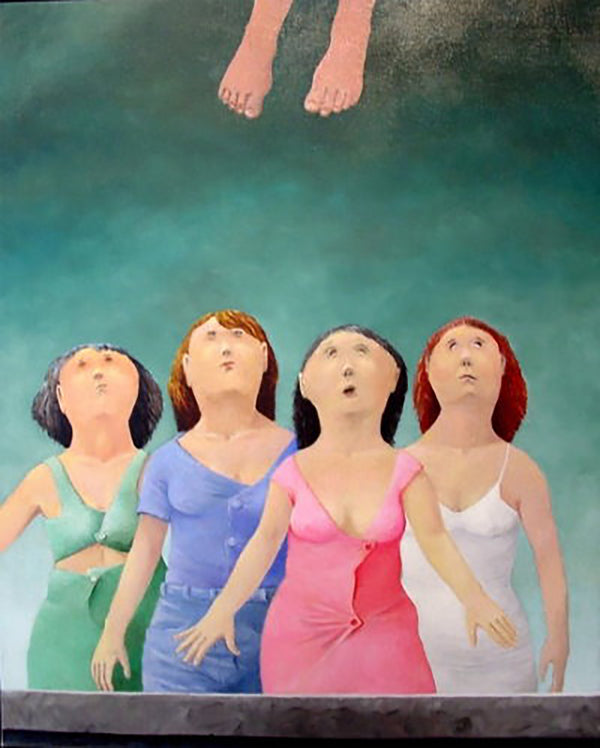
Dolf Zwerver: the silence behind the hedges
Oct 28, 2026
In Dolf Zwerver’s paintings, people walk between tall hedges, sit in enclosed gardens or stand half hidden in a wood. Everything is recognisable, yet rarely entirely logical. In an interview from 1986 he said:
“Really, I can only talk through my little paintings.”
From window cleaner to painter
Dolf Zwerver was born on 27 February 1932 in Nijehaske, in the Dutch province of Friesland. He spent part of his childhood in Oranjewoud and part in Utrecht, where as a boy he lived above a cigar shop in the Zadelstraat.
He had no formal art training. He worked as a sign painter, sailor, carpenter, window cleaner and apprentice tile painter at the Westraven pottery, among other jobs. He painted in his spare time until, in the late 1950s, he chose a career as a painter.
At first, the Utrecht artists’ society Genootschap Kunstliefde kept its doors closed to him, until in 1965 he won a competition for Sunday painters run by the women’s magazine Eva. After that, things moved quickly. He got to know artists such as Peter Vos, Charles Donker and Gerard van Rooy, and within a few years developed into a meticulous, highly detailed painter. He did eventually become a member of Kunstliefde, from 1968 to 1978 and from 1984 to 1996.

Dolf Zwerver, Veiled with egg, 1976
Rhijnauwen and Oranjewoud
Peter Vos took Zwerver to the Rhijnauwen estate, on the edge of Amelisweerd. It became his favourite place. His paintings, he said, were always about silence, and that was where he found it.
The landscape reminded him of Oranjewoud, with its avenues and, above all, its hedges. He kept painting those hedges throughout his career. They protect you and mark out your world, he said, but they are also a barrier.
“What happens behind those hedges is not always entirely clear.”
Mazes were familiar to him from everyday life too: he easily lost his way. As a boy he already had to ask for directions on the Vismarkt, and by his own account he could never find anything at Rhijnauwen, however often he went there.

Dolf Zwerver, Woman in a garden, 1988
Painting what was in his head
Zwerver painted what was in his head. What mattered to him was atmosphere, not an accurate rendering:
“None of it is bloody right, not anatomically, not in perspective.”
As long as he achieved the atmosphere, the route to it could be a crooked one. He compared it to a bird singing above your head: if you look to see which bird it is, it flies off and the wonder is over.
His early paintings were classed as naïve art; others called his work magic realist. That very recognisability also drew criticism: many people found his paintings too easy.

Dolf Zwerver, Outside the tent, 1987
Sanssouci, museums and exhibitions
Zwerver’s best-known work is the Groot Drieluik Sanssouci, a triptych he worked on for ten years in total. It can be seen in Utrecht town hall. The Centraal Museum in Utrecht holds works including Doolhofje (1969), Huisje met dreef (1971) and De gang (1979). His work also appears on the covers of seven poetry collections by the Utrecht poet Ingmar Heytze.
Slot Zeist devoted major retrospectives to him in 1994 and 2002. A book about his work also appeared in 1994, with texts by Hella S. Haasse and others. Dolf Zwerver died in Utrecht on 22 January 2010. Later that year Slot Zeist held the memorial exhibition De ziel van Zwerver (The Soul of Zwerver).
Sources and literature
Bert van den Hoed, episode 32 of his series on the Utrechts Nieuwsblad photo archive, Facebook page of Het Utrechts Archief, with quotations from a 1986 interview with Dolf Zwerver.
Centraal Museum Utrecht, collection records for Dolf Zwerver and Sanssouci.
Historische Vereniging Oud-Utrecht, Historisch Café on Dolf Zwerver, 9 February 2024.
Nieuws030, ‘Lezing Ingmar Heytze over schilder Dolf Zwerver’, 10 February 2024.
Utrecht aan Zee, film description ‘De reizen van Ingmar Heytze’.
Jan Juffermans, Dolf Zwerver: schilder in een doolhof, with contributions by Ingmar Heytze, Kees Visser and Jan van Gool, Utrecht 2002.
Hans Lutz, Hella S. Haasse and Leo Boudewijns, Dolf Zwerver, Zutphen 1994.
Rijksmuseum, poster for the exhibition at Slot Zeist, 1994.